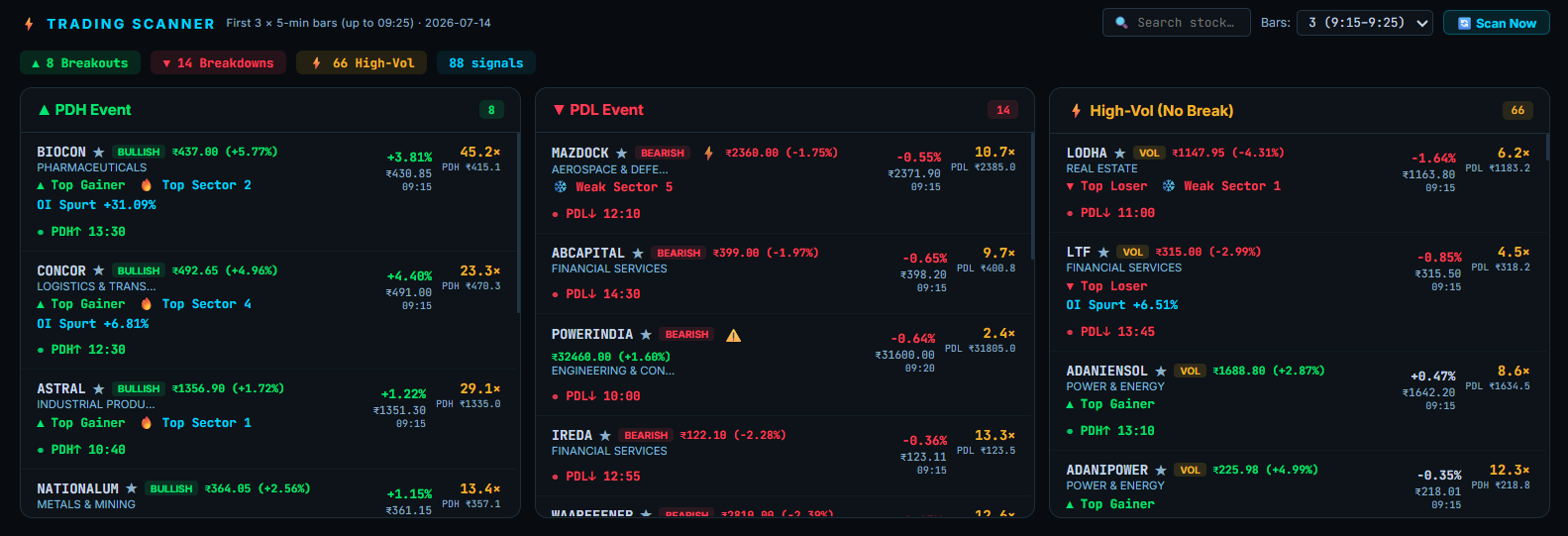
The gap between "I have a scanner" and "the scanner is actually finding stocks I'd want to trade" is entirely about the filters you set. A first scan built loosely will either flood you with noise or return nothing useful. Here's a simple way to set one up properly.
Step 1: Start with a market context check
Before building any filter, glance at Market Pulse — the Bull/Bear Ratio and overall breadth. This doesn't change your filter settings, but it tells you what kind of results to expect and trust more: on a strongly bullish day, breakout scans are more likely to be reliable than breakdown scans, and vice versa.
Step 2: Choose one condition to start
Resist the urge to combine five conditions on your first scan. Start with something simple and well understood — for example, stocks breaking above their previous day's high on volume meaningfully above their own average. One clear condition is easier to evaluate than a complex combination you don't yet have a feel for.
Step 3: Narrow by sector strength
Once your base filter is returning results, cross-reference them against the sector heatmap. Results in the day's strongest sectors deserve more attention than the same technical pattern showing up in a lagging sector — this single step meaningfully improves the quality of what your scan surfaces.
Step 4: Save the preset and refine over time
- Save your first scan as a preset so you're not rebuilding it every session.
- Track how its results actually performed over a couple of weeks before making changes.
- Adjust one variable at a time — volume threshold, sector filter, or condition — so you can tell what the change actually did.
- Build a second, different scan once your first one feels reliable, rather than overcomplicating the first.
A scanner is only as good as the filter behind it. Starting simple, checking results against context, and refining gradually gets you to a genuinely useful scan much faster than trying to build the perfect filter on day one.
TradingPulse is a decision-support tool that helps traders filter the market and trade with a more structured, rule-based approach. It does not provide investment advice or guarantee profits. See our Disclaimer.